
Circuitscape
Open-source tools for connectivity modeling using circuit theory. All free and open source.
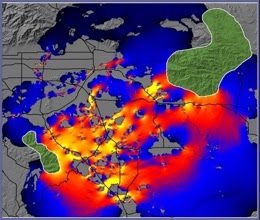
Circuitscape borrows algorithms from electronic circuit theory to predict connectivity in heterogeneous landscapes. It considers the effects of all possible pathways simultaneously, making it the most widely used connectivity analysis package in the world.
Omniscape offers a "coreless" approach by applying Circuitscape iteratively in a moving window to predict omni-directional connectivity.
Linkage Mapper uses least-cost corridor analysis, circuit theory, and barrier analysis to map corridors, detect pinch-points and restoration opportunities, and identify important core areas and corridors.
Gnarly Landscape Utilities automates the creation of core area maps and resistance layers needed for connectivity modeling.
Watch NASA's Ecological Forecasting video on applying circuit theory to animal movement with Circuitscape.
Applications from Around the World
Circuitscape is used across a wide range of fields including wildlife corridor design, landscape genetics, movement ecology, connectivity for climate change, infectious disease, fire, and agriculture, complementary models, and hybrid approaches. Explore all applications of Circuitscape.
Awards
Circuitscape received the 2013 Spatial Ecology and Telemetry Working Group (SETWG) Award from The Wildlife Society, recognizing its significant contributions to the field of wildlife biology.
Authors
Circuitscape was created by Brad McRae (1966-2017), Viral B. Shah, Tanmay Mohapatra, and Ranjan Anantharaman. Brad's vision and dedication to conservation science continue to inspire the project. More details about the authors here.
Acknowledgments
We are especially grateful to NASA and The Nature Conservancy for Circuitscape 5.0, a major upgrade to Circuitscape using the Julia language. The Wilburforce Foundation funded Circuitscape 4.0 and the Python version of Circuitscape. The Cougar Fund also contributed to the original development. We also wish to thank the Washington Program of The Nature Conservancy and the National Center for Ecological Analysis and Synthesis for supporting Brad McRae and the University of California, Santa Barbara for supporting Viral B. Shah while they collaborated on the project.