
Publications and Impact
Circuitscape has become the most widely used connectivity analysis package in the world. It is used by numerous state, federal, and local agencies in the USA, and by government ministries and NGOs for conservation planning on six continents. It routinely appears in journals like PNAS, Nature Genetics, Ecology, Ecological Applications, Ecology Letters, Landscape Ecology, Evolution, Heredity, Bioscience, Molecular Ecology, Conservation Biology, and many others.
Circuitscape has been cited in over 2,500 peer-reviewed publications. See Google Scholar for a current list.
McRae, B.H., B.G. Dickson, T.H. Keitt, and V.B. Shah. 2008. Using circuit theory to model connectivity in ecology and conservation. Ecology 10: 2712-2724. (pdf)
Methods
McRae, B.H. 2006. Isolation by resistance. Evolution 60:1551-1561. (pdf)
McRae, B.H. and P. Beier. 2007. Circuit theory predicts gene flow in plant and animal populations. Proceedings of the National Academy of Sciences of the USA 104:19885-19890. (pdf)
Applications
McRae, B.H., V.B. Shah, and A. Edelman. 2016. Circuitscape: Modeling Landscape Connectivity to Promote Conservation and Human Health. The Nature Conservancy, Fort Collins, CO. 14 pp.
Brett G. Dickson, Christine M. Albano, Ranjan Anantharaman, Paul Beier, Joe Fargione, Tabitha A. Graves, Miranda E. Gray, Kimberly R. Hall, Josh J. Lawler, Paul B. Leonard, Caitlin E. Littlefield, Meredith L. McClure, John Novembre, Carrie A. Schloss, Nathan H. Schumaker, Viral B. Shah, and David M. Theobald. Circuit-theory applications to connectivity science and conservation. Conservation Biology (2018). (pdf) Supplementary Material. Database of papers cited in this review.
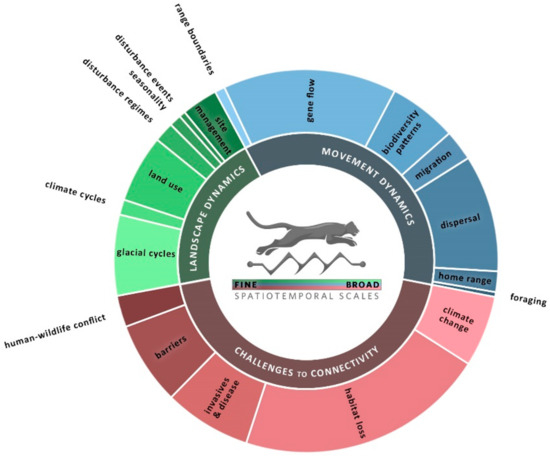
Distribution of 572 Circuitscape applications across the Zeller et al. framing of topics in dynamic connectivity. Applications are grouped into three broad categories (inner circle), and then arranged in categories that range from finer scale (spatial or temporal) studies in darker shades, to applications at larger scales and/or longer focal time periods (lighter shades). From Hall et al. (2021).
Software
Hall K.R., R. Anantharaman, V.A. Landau, M. Clark, B.G. Dickson, A. Jones, J. Platt, A. Edelman, V.B. Shah. 2021. Circuitscape in Julia: Empowering Dynamic Approaches to Connectivity Assessment. Land 10(3):301. Supplemental material.
Shah, V.B. and B.H. McRae. 2008. Circuitscape: a tool for landscape ecology. In: G. Varoquaux, T. Vaught, J. Millman (Eds.). Proceedings of the 7th Python in Science Conference (SciPy 2008), pp. 62-66. (pdf)
Shah, V.B. 2007. An Interactive System for Combinatorial Scientific Computing with an Emphasis on Programmer Productivity. PhD thesis, University of California, Santa Barbara.
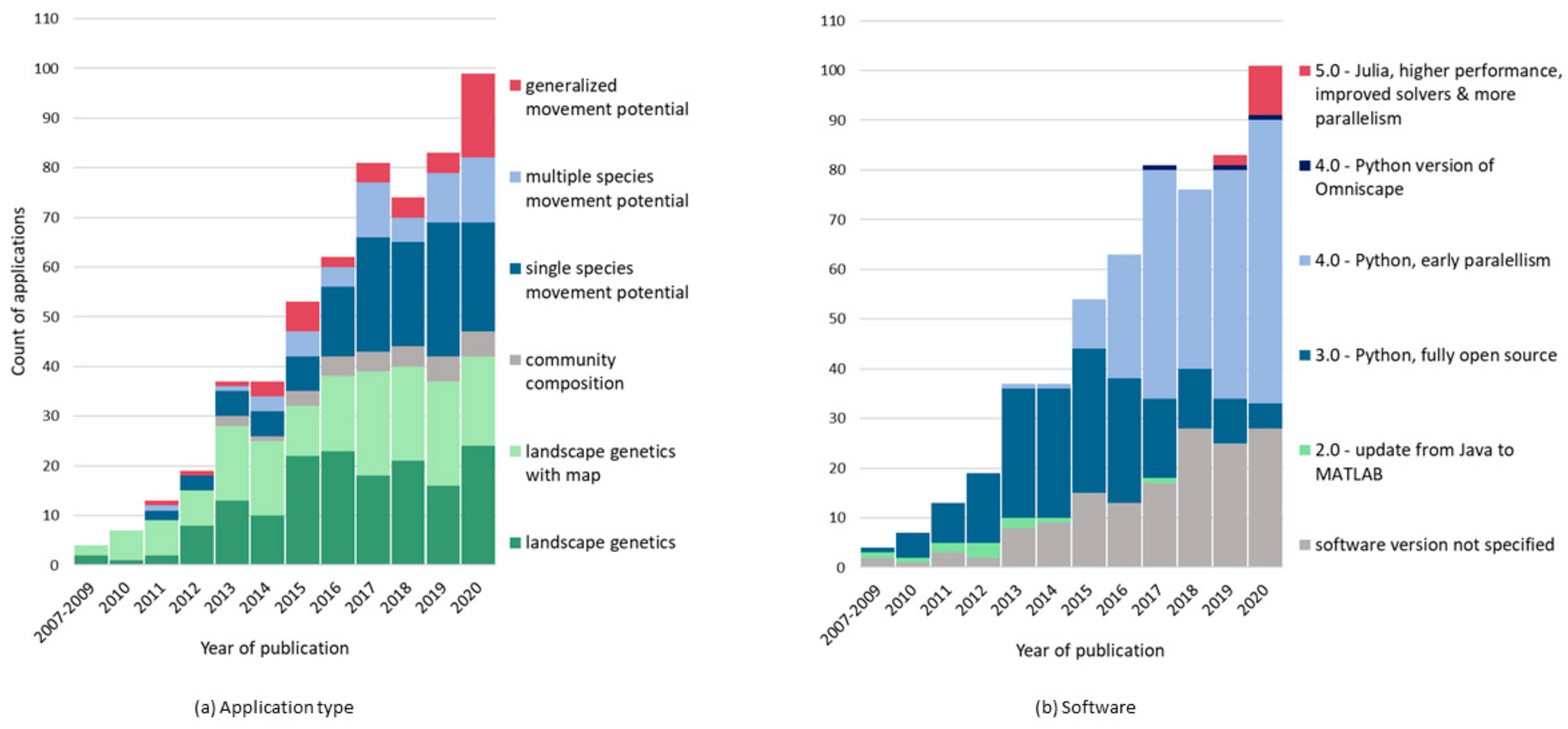
Count of Circuitscape applications in peer-reviewed journal articles by year, categorized by (a) type of application and (b) version of the software. From Hall et al. (2021).
Media
"One glorious map" (2016) — a widely shared visualization using Circuitscape to model species responses to climate change. Coverage in The Nature Conservancy and Smithsonian Magazine.
Circuitscape on the cover of Methods in Ecology & Evolution (2013)
"Where the wild things are" in UC Santa Barbara Convergence magazine, by Anna Davison (2010)
Circuitous Routes in Conservation Magazine, by Eric Wagner (2008)
Scientist Employs Circuit Theory to Protect Endangered Species in Wired magazine, by Carl Zimmer (2007)